> For the complete documentation index, see [llms.txt](https://docs.omnivatelehealth.com/llms.txt). Markdown versions of documentation pages are available by appending `.md` to page URLs; this page is available as [Markdown](https://docs.omnivatelehealth.com/admin/configuration/service-and-provider-pricing.md).
# Service & Provider Pricing
## **How do consultation fees work? Base Price vs Slot-Based Pricing**
In Omniva, pricing is tied to **both the service configuration** (whether it is set to *Base Price* or *Slot-Based Price*) **and the provider’s availability** (slot duration of 10, 20, 30 minutes, etc.).
There are **two pricing models**:
***
### 1. Base Pricing
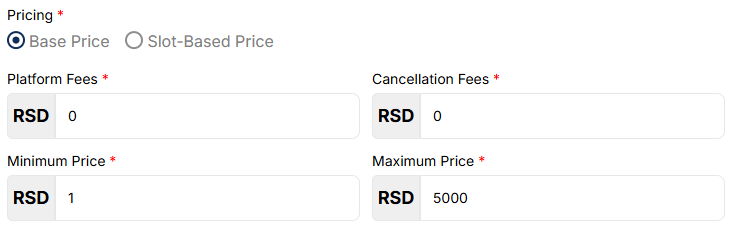
Base Pricing means the service has a **single consultation fee**, which is then proportionally split across the slot duration defined in provider availability.
#### Service Setup:
* Service requires:
* **Min Price, Max Price**
* **Platform Fee**
* **Cancellation Fee**
#### Provider Setup:
* When creating or updating their profile, the system asks for:
* **Single consultation price**
* **Follow-up consultation price**
* Omniva automatically **splits this consultation price based on slot duration**.
* Patients see a **per-slot amount**, not the full consultation price.
#### Example:
* Provider sets Consultation Price = **RSD 100**.
* Provider availability: **10 min slots**.
* Patient books 1 slot → sees **RSD 10** as service fee.
* If the provider sets 30-minute slots → patient books 1 slot → sees **RSD 30**.
**Use Case:**
* Standard consultations where **pricing is split proportionally** across time slots.
* Keeps things consistent when providers only want to manage **one global consultation fee**.
### 2. Slot-Based Pricing
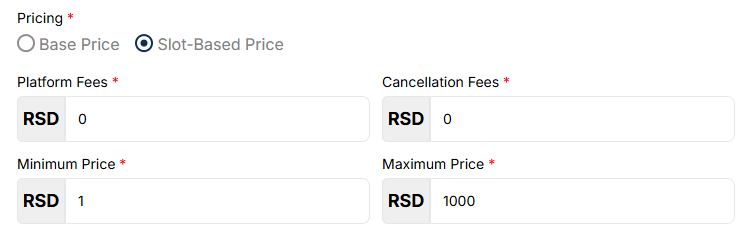
Slot-Based Pricing means the service fee is **defined separately for each slot duration** (10, 20, 30 min, etc.) and is not auto-split.
#### Service Setup:
* Service requires:
* **Min Price, Max Price**
* **Platform Fee**
* **Cancellation Fee**
#### Provider Setup:
* When creating or updating their profile, the system asks for:
* Different slot pricing for each available duration (e.g., 10 min, 20 min, 30 min).
* Patients see the exact slot-based fee the provider set.
#### Example:
* Provider sets:
* 10 min = RSD 1,000
* 20 min = RSD 1,800
* 30 min = RSD 2,500
* Availability = **20 min slots**.
* Patient books 1 slot → sees **RSD 1,800**.
* If provider updates availability to 30 min slots → patient booking = **RSD 2,500**.
**Use Case:**
* Flexible consultations where **time directly impacts cost**.
* Useful for specialists who want to charge **different rates for different session lengths**.
### Key Differences:
| Aspect | Base Pricing | Slot-Based Pricing |
| ---------------------- | ------------------------------------------------------------------------- | ---------------------------------------------------------------------------------- |
| **Pricing Basis** | One global consultation price → auto-split into slots | Each slot duration has its own price |
| **Provider Input** | Sets only single consultation + follow-up fee | Defines separate pricing for 10/20/30 min slots |
| **Patient Experience** | Sees **split amount** (e.g., 100 RSD consultation → 10 min slot = 10 RSD) | Sees **direct price for that slot** (10 min = 1,000 RSD, 20 min = 1,800 RSD, etc.) |
| **Best For** | Standardized consultations, simple setup | Time-sensitive consultations, flexible pricing |
---
# Agent Instructions
This documentation is published with GitBook. GitBook is the documentation platform designed so that both humans and AI agents can read, navigate, and reason over technical content effectively. Learn more at gitbook.com.
## Querying This Documentation
If you need additional information that is not directly available in this page, you can query the documentation by asking a question.
Perform an HTTP GET request on the following URL with the `ask` and `goal` query parameters:
```
GET https://docs.omnivatelehealth.com/admin/configuration/service-and-provider-pricing.md?ask=&goal=
```
`ask` is the immediate question: it should be specific, self-contained, and written in natural language.
`goal` is what the user is ultimately trying to achieve, the reason they need the answer. Sharing it helps GitBook give you a better, more relevant answer. A goal is most helpful when it describes the outcome the user wants rather than restating the question. For example, with `ask=how do I create an API token`, a goal like `automate deployments from our CI pipeline` lets GitBook tailor the answer to that use case.
The response will contain a direct answer to the question and relevant excerpts and sources from the documentation.
Use this mechanism when the answer is not explicitly present in the current page, you need clarification or additional context, or you want to retrieve related documentation sections.